
LCA Live · Report Generator
5,527 rows in. A 38 page ISO report out.
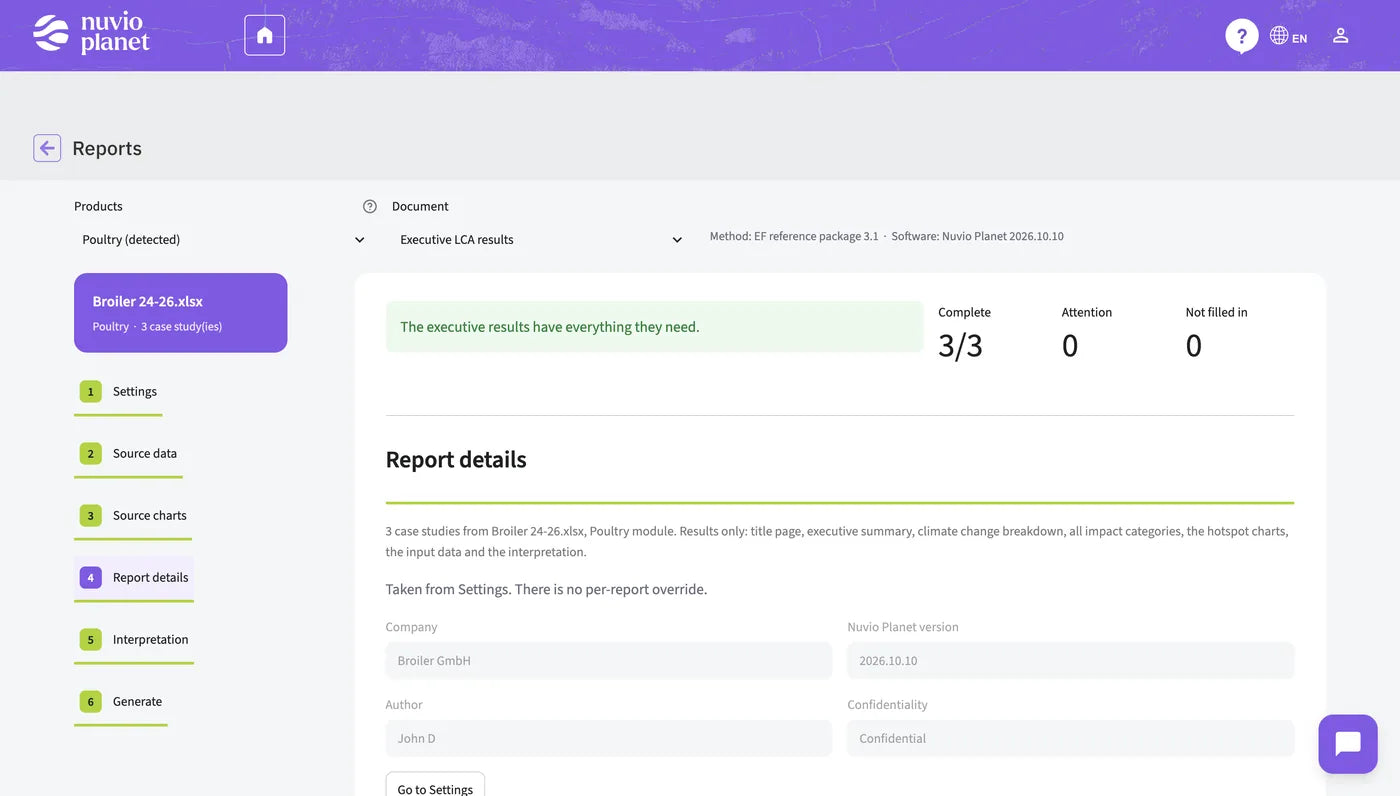
The Report Generator is built into LCA Live. It turns your LCA results into an ISO 14040 and 14044 structured report: your brand, your numbers, every figure checked against your results.
Built for the people who have to defend the number: the analyst who ran the model, the buyer who signs the purchase order, the finance team that re-adds the annex.
- You export
- Finish the case study in LCA Live and export it. One scenario or twenty.
- You edit
- Check the hotspots, fill in goal and scope, rewrite any sentence you like.
- You download
- Word and PDF, branded, charts embedded, every ISO element accounted for.
The part nobody budgets for
The model is finished. The work has barely started.
You export to Excel. You paste tables into the Word file from last year. You rebuild the charts, rewrite the method section, and check every figure twice. Weeks, for a document that says what the model already knew.
The deadline is usually set by somebody else. A customer questionnaire, a PEFCR submission, a CSRD disclosure.
How it works
Export. Edit. Download.
Three steps inside LCA Live, from finished case study to a branded Word and PDF report.
-
Export
Finish the case study in LCA Live and export it. One scenario or twenty.
-
Edit
Check the hotspots, fill in goal and scope, rewrite any sentence you like.
-
Download
Word and PDF, branded, charts embedded, every ISO element accounted for.
Why it holds up
Built for the person who has to defend the number.
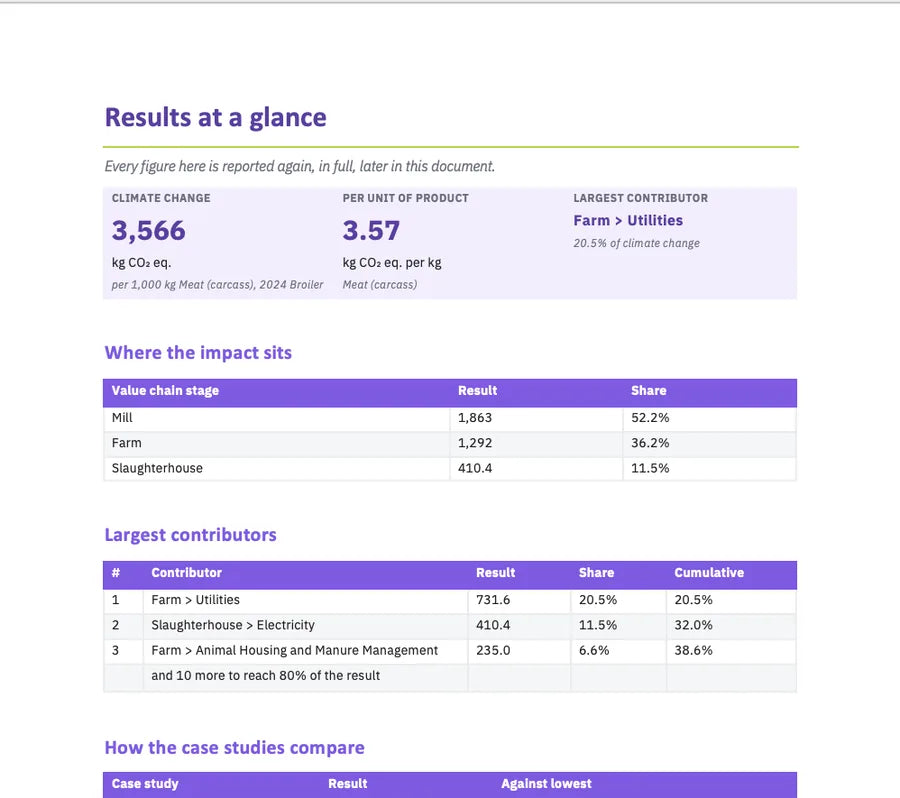
Three people read what comes out of the Report Generator. One of them ran the model. The other two did not, and they will both go looking for the figure that does not add up. The summary figure and the annex figure are the same figure, and the annex shows the working.
Four things the report will not let slide
-
Every figure reconciles
Nineteen arithmetic checks run before a word is written. Stage contributions are re-derived against the total for all nineteen indicators. Individual ingredients are checked against the ingredients step. The results are printed in the annex to four decimal places, because somebody in finance is going to re-add them.
-
A live ISO checklist
Functional unit, cut-off criteria, allocation, data quality, the completeness, consistency and sensitivity checks. Sixty-three compliance checks track each element against its clause as you fill the form. You find the gap before your reviewer does.
-
It refuses to fake a comparison
Load a carcass weight scenario beside a live weight one. The report groups them by reference flow and prints a non-comparability statement. It will not quietly convert between reference flows to make a chart look tidy. That is one fewer sentence for your legal team to strike out later.
-
Hotspots down to the ingredient and its origin
Contribution analysis runs past the life cycle stage, down to the individual feed ingredient, its country of origin and the driver behind it. Procurement gets a name and a number on the same page, not a total they cannot act on.
From the bundled broiler sample
Half the footprint is one ingredient.
Half the footprint is one ingredient.
- Brazilian soybean meal accounts for 49.7% of the climate change total for 1,000 kg of broiler meat, carcass weight. Land use change accounts for 52.1% of it.
- One sourcing decision moves half the number. The report names the ingredient, the origin and the driver on the same page as the total.
- The person who signs the purchase order can read it without a call. Finance gets the same treatment: the summary figure and the annex figure are the same figure.
- 49.7%
- Brazilian soybean meal, share of the climate change total
- 50.3%
- All other inputs
- 52.1%
- Land use change, of the same total
- 38
- pages in the sample report from a three-scenario export, reconciliation annex included
AI-enabled
The model writes the sentences. It never touches the arithmetic.
Switch the language model on and it drafts your executive summary, your hotspot interpretation and your recommendations. It is handed the figures. It is never allowed to calculate one.
What the check actually is. The Report Generator does not verify your data. It verifies that the report says what your data says. Every number in the generated text is matched against your results before the document is built, with a tolerance of half a percent.
Anything that fails is thrown away and the deterministic draft is used instead, with the reason shown on screen. Turn the model off and it still writes the whole draft. Run it twice, get the same words.
What passes, what does not
- Pass A figure from your results, at any level of the contribution analysis.
- Pass A standard citation. ISO 14044, IPCC Table 10.18, EF 3.1, an EU feed code.
- Fail An industry average the model recalled from somewhere else.
- Fail A total that is off by more than half a percent.
- Fail Any number that cannot be traced back to your own data.
Method, data and software version on record
Our feed module is certified by OVOCOM, BFA and ILVO for ISO 14040/44, PEFCR Feed and GFLI.
What the Report Generator produces is the document a person reads and an auditor signs. It is not a machine-readable exchange record.
Results depend on the primary data you enter. A comparative assertion disclosed to the public requires an independent critical review under ISO 14044.
Figures shown on this page are from the bundled broiler sample and are not a benchmark.
LCA Live · Software platform
Bring one product. We model it with you, live.
A feed recipe or a finished product: you pick it, we model it in LCA Live with your team in one working session.
What happens next
- You pick a slot in our calendar.
- You choose the product you want to see.
- We model it with your team in one working session.
LCA Live is priced per engagement. We scope it with you after the session.